

The next evolution of Delta - Catalog-Managed Tables
The data ecosystem is moving toward a catalog-centric model for managing open table formats. As open catalogs gain adoption, the catalog has emerged as the system of record for table identity, discovery, and authorization.
With Delta Lake 4.1.0, Delta introduces catalog-managed tables, which establish the catalog as the coordinator of table access and source of truth for table state. This simplifies how tables are discovered and secured, enables consistent governance across engines, and unlocks faster performance. The design also aligns Delta with the catalog-managed model pioneered by Iceberg, creating a shared foundation for interoperable, high-performance lakehouse tables.
Unity Catalog is the first open lakehouse catalog to support catalog-managed tables, extending unified governance across any format.
What are Catalog-Managed Tables?
Catalog-managed tables are tables for which the catalog brokers table access as well as stores the table’s latest metadata and commits. Clients reference the table by name, not by path, and use the catalog to resolve the table’s storage location. The catalog also manages concurrency control for proposed writes to a table. Writers leverage the catalog, not object store APIs, for atomic commits.
For more details, see the Delta protocol RFC on Github here. See how Unity Catalog implements support for the Catalog-Managed Tables specification here.
Before: Challenges with Delta tables that were managed by the filesystem
Before catalog-managed tables, the filesystem – not the catalog – was the primary authority for table access and changes to table state.
To access filesystem-managed Delta tables, Delta clients first look at the transaction log (_delta_log) stored with
the table to determine the latest version. Clients then reconstruct the current state of the table by replaying the log
entries, which describe the table’s schema and data files that belong to the table. Once the table state is known, the
system reads the relevant data files to answer the query. When writing to the table, clients write new data files to
storage and then atomically commit a new transaction log entry via filesystem APIs to advance the table to a new
version.
Historically, data teams have faced the following challenges with filesystem-managed Delta tables:
- Brittle path-based access: Delta clients have to know the exact path of the filesystem-managed table they are accessing, and credentials have to be provisioned directly by the storage system. This tightly couples applications to physical storage locations, so routine changes like table relocation, storage reorganization, or credential rotation could break pipelines and queries.
- Risky coarse-grained authorization: Filesystems lack fine-grained access control, so complying with data privacy requirements often requires splitting datasets across multiple tables or storage paths to isolate sensitive fields or records. This leads to duplicated data, fragmented governance, and fragile pipelines.
- Unsafe schema changes: Path-based writes can modify table schemas or metadata without validation, potentially introducing incompatible changes that break downstream workloads. This occurs because storage credentials cannot distinguish between clients authorized to write data and those authorized to modify table metadata.
- Bottlenecked performance: Replaying the Delta transaction log to resolve a table’s latest state requires multiple calls to the filesystem, which can add 100+ ms to query execution.
Now: Catalog-Managed Delta Tables address these challenges
Catalog-managed tables address the governance and performance challenges by involving the catalog in read, write, and authorization coordination. This way, teams can unlock:
- Standardized table discovery: The catalog provides stable logical table identifiers (such as Unity Catalog’s three-level namespace), eliminating the need for clients to depend on physical storage paths for discovery.
- Unified governance: The catalog is responsible for granting clients access to data, rather than teams needing to manage fragmented access policies across their storage systems. This dramatically simplifies how data teams ensure engines access their data in a governed manner.
- Enforceable constraints: The catalog can authoritatively validate or reject schema and constraint changes, preventing incompatible updates that could compromise data integrity or break downstream workloads.
- Faster query planning and faster writes: If a Delta client is trying to access a table, the catalog can directly inform it of the table-level metadata. This skips cloud storage entirely and removes a major source of metadata latency. This feature also opens the door for “inline commits” where the (metadata) content of the commit is sent directly to the catalog.
Catalog-managed Delta tables dramatically simplify how engines discover and access data under consistent governance, all while improving read and write performance. Table state updates are flushed to the filesystem, reinforcing Delta’s openness and portability.
How do Catalog-Managed Tables work?
The Catalog-Managed Tables Delta feature fundamentally changes how Delta tables are discovered, read, and committed to.
Table Discovery
For catalog-managed tables, Delta tables are discovered and accessed through the catalog, not by filesystem paths. Engines must first resolve a table by name via the catalog, establishing table identity, location, and access credentials. This resolution step occurs before the Delta client interacts with the filesystem and determines the rules the client must follow for subsequent reads and writes.
Reads
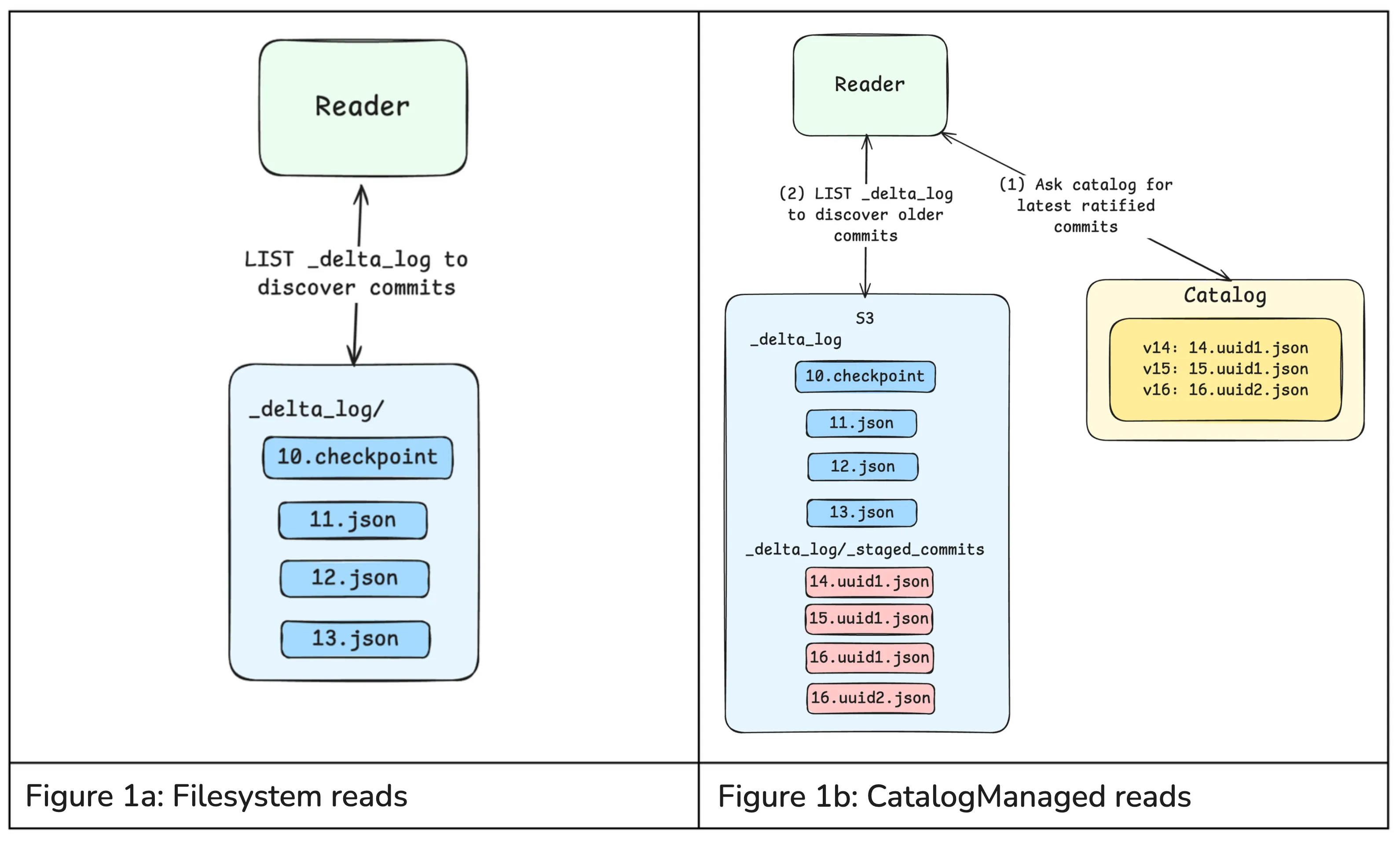
A catalog-managed table may have commits that have been ratified by the catalog but not yet flushed, or “published”, to the filesystem. Reads therefore begin by getting these latest commits from the catalog, typically via a get_catalog_commits API exposed by the catalog.
If additional history is required, such as older published commits or checkpoints, Delta clients can LIST the filesystem and merge those published commits with the catalog-provided commits to construct a complete snapshot. This split view allows catalogs to always provide the most recent table state while offloading long-term commit storage to the filesystem.
Writes
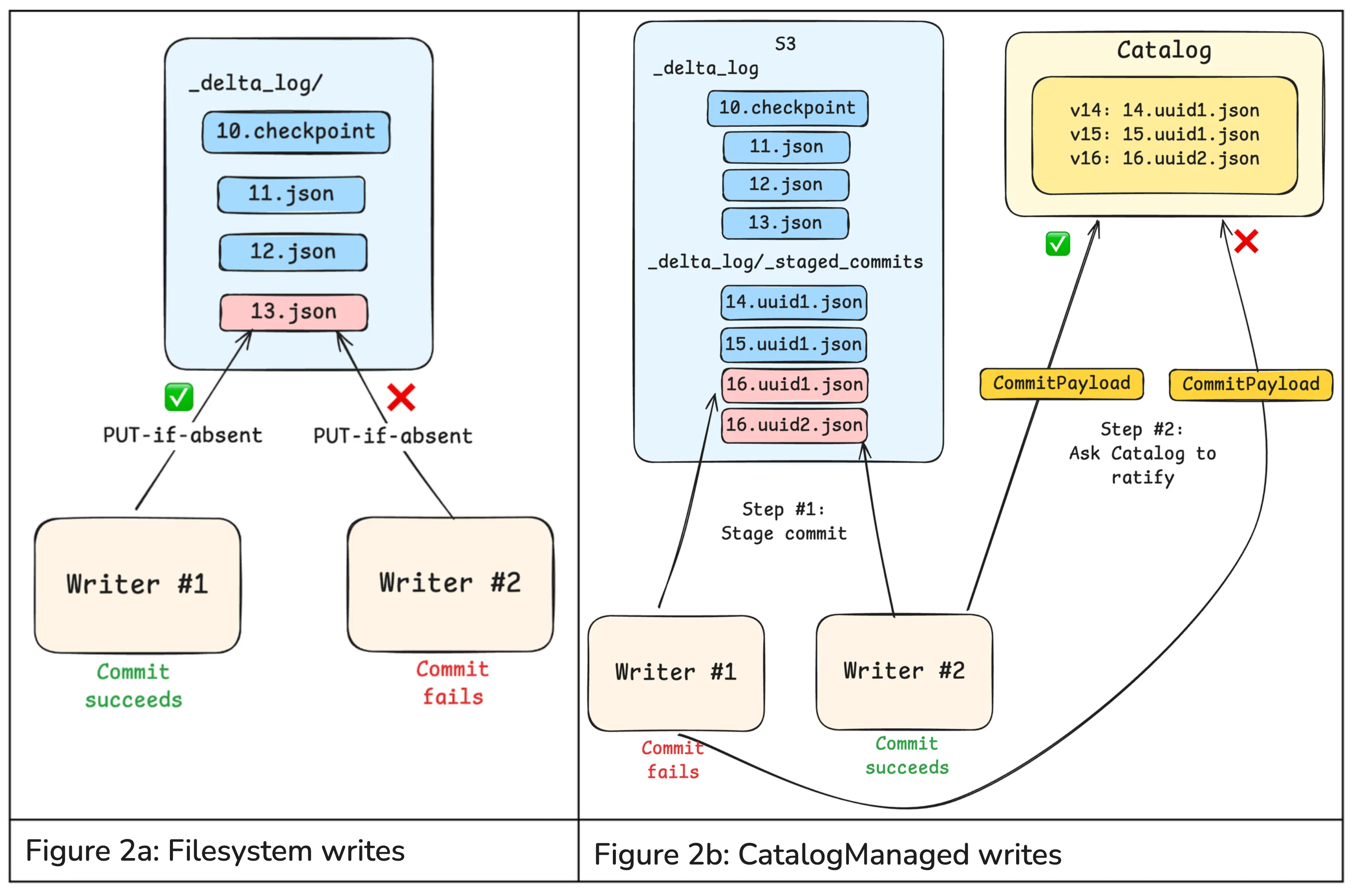
Previously, writing to a Delta table involved calling filesystem “PUT-if-absent” APIs to perform atomic writes with mutual exclusion. In this model, the filesystem determined which writes win. While simple and scalable, this approach treated commits as opaque blobs: the filesystem could not inspect commit contents, enforce constraints, or coordinate writes across tables.
For catalog-managed tables, clients propose commits to the catalog, typically by first staging commits in the filesystem’s <table_path>/_delta_log/_staged_commits directory and then requesting ratification. Staging ensures that readers never observe unapproved commits. The protocol also allows for “inline” commits, where the contents of the commit are sent directly to the catalog, skipping the 100ms+ filesystem write. Staged commits are still performed using optimistic concurrency control to provide transactional guarantees.
Catalogs can also define their own commit APIs, allowing them to accept richer commit payloads, inspect actions and metadata, enforce constraints, and apply catalog-level policies before ratifying a commit.
To unburden catalogs from having to store these ratified commits indefinitely, ratified commits can be periodically “published” to the _delta_log in the filesystem. Once published, catalogs no longer need to retain or serve those commits because clients can easily discover them by listing.
Evolving open table formats
Catalog-managed Delta tables represent a critical convergence between how data is stored and how it is governed. Open table formats and open catalogs are evolving together so that governance becomes a native property of the table itself rather than an external overlay.
As an added benefit, Delta’s new catalog-oriented design closely resembles that of Iceberg tables. Ultimately, this makes it simpler for practitioners to discover and govern data consistently, regardless of table format.
We are excited to continue collaborating with the ecosystem to evolve Delta with open catalogs so that they deliver performant commits, efficient metadata management, multi-engine interoperability, and unified governance.
Getting started with Catalog Managed Tables
To get started with Catalog Managed Tables, you’ll need both Delta Lake 4.1.0 and Unity Catalog 0.4.0 installed, and additionally, you’ll need to opt into the catalog-managed feature.
We’ve simplified this process for you by providing a full docker environment called unitycatalog-playground which can be used as a starting point to test out this new functionality.
Enabling Catalog Managed Tables in Unity Catalog
The server.properties file of the Unity Catalog server (/etc/conf/server.properties) must contain the following:
## Experimental Feature Flags
# Enable MANAGED table (experimental feature)
# Default: false (disabled)
server.managed-table.enabled=true

# Set the UC storage root
storage-root.tables=/path/to/data/dir
Note: This properties file can be viewed in full here.
Note: This guide is a truncated version of the Unity Catalog Playground guide.
1. Configure your Spark Session
This step configures your Spark Session to use the Unity Catalog UCSingleCatalog, enabling the use of the catalog-managed tables feature.
DELTA_VERSION='4.1.0'
UNITY_CATALOG_VERSION='0.4.0'
unity_catalog_server_url = "http://unitycatalog:8080"

config = {
    "spark.jars.packages": f"io.delta:delta-spark_4.1_2.13:{DELTA_VERSION},io.unitycatalog:unitycatalog-spark_2.13:{UNITY_CATALOG_VERSION}",
    "spark.sql.extensions": "io.delta.sql.DeltaSparkSessionExtension",
    "spark.sql.catalog.spark_catalog": "org.apache.spark.sql.delta.catalog.DeltaCatalog",
    f"spark.sql.catalog.unity": "io.unitycatalog.spark.UCSingleCatalog",
    f"spark.sql.catalog.unity.uri": unity_catalog_server_url,
    f"spark.sql.catalog.unity.token": "",
    "spark.sql.defaultCatalog": catalog,
}

spark_config = (
    SparkConf()
        .setMaster('local[*]')
        .setAppName("DeltaCatalogManagedTables")
)
for k, v in config.items():
    spark_config = spark_config.set(k, v)

# build the session
spark: SparkSession = SparkSession.builder.config(conf=spark_config).getOrCreate()
2. Create a Schema and your first Catalog Managed Table
With your session running, create a dedicated schema and then define your table using CREATE TABLE … USING DELTA with the delta.feature.catalogManaged table property set to supported. This single property is what opts the table into catalog-managed commits — without it, Delta falls back to standard filesystem-based coordination.
spark.sql("CREATE SCHEMA IF NOT EXISTS unity.sanctuary")

ddl = """
CREATE TABLE IF NOT EXISTS sanctuary.pets (
    uuid    STRING  NOT NULL,
    name    STRING  NOT NULL,
    age     INT     NOT NULL,
    adopted BOOLEAN NOT NULL
)
USING DELTA
TBLPROPERTIES ('delta.feature.catalogManaged' = 'supported')
"""
spark.sql(ddl)
3. Populate your Table
Now that you have a table, let’s add some records to it. We’ll be using the generate_pets and pets_to_dataframe
methods from the unitycatalog-playground library to
generate some random data.
# create 100 pets, grouped into litters of 10 pets
pets = generate_pets(batch_size=10, total=100)
litter_one = next(pets, None)
df = pets_to_dataframe(litter_one, spark)

# add the first set of records
df.write.format("delta").mode("append").saveAsTable("sanctuary.pets")

# now continue until we've accounted for all pets
for litter in pets:
    pets_to_dataframe(litter, spark).write.format("delta").mode("append").saveAsTable("sanctuary.pets")
4. Explore your Table
Let’s find all pets who still need to find a home.
spark.sql("select * from sanctuary.pets where NOT adopted").show()Given the randomly generated data, you might have more or less pet’s who need to be adopted still. In this case, there are four pet’s left (Otis, Dexter, Bentley, and Fern).
+--------------------+-------+---+-------+
|                uuid|   name|age|adopted|
+--------------------+-------+---+-------+
|100a76bf-d328-478...|   Otis|  7|  false|
|aeb930bd-d189-46e...| Dexter|  6|  false|
|bae52223-bac0-436...|Bentley| 12|  false|
|0bddb1b0-4cf0-457...|   Fern| 14|  false|
+--------------------+-------+---+-------+
Now you might be thinking that this feels the same as any standard Delta Lake workflow with Spark and you’d be correct. This is the magic of the catalog-managed feature. The catalog is the single source of truth for table state, and you no longer need to worry about the filesystem.
5. View the Catalog Commits
We can view the catalog commit metadata using the Unity Catalog API. To query this API endpoint, we’ll need to have the uuid of our table. We can get that by running the following query.
spark.sql("describe extended sanctuary.pets").show(truncate=False)This will show us the following:
+----------------------------+----------------------------------------------------------------------------------------------+-------+
|col_name                    |data_type                                                                                     |comment|
+----------------------------+----------------------------------------------------------------------------------------------+-------+
|uuid                        |string                                                                                        |NULL   |
|name                        |string                                                                                        |NULL   |
|age                         |int                                                                                           |NULL   |
|adopted                     |boolean                                                                                       |NULL   |
|                            |                                                                                              |       |
|# Detailed Table Information|                                                                                              |       |
|Name                        |unity.sanctuary.pets                                                                          |       |
|Type                        |MANAGED                                                                                       |       |
|Location                    |file:/home/unitycatalog/etc/data/__unitystorage/tables/bfff9405-4b50-43e9-870b-2b25f2210cf2   |       |
|Provider                    |delta                                                                                         |       |
|Is_managed_location         |true                                                                                          |       |
|Table Properties            |[delta.feature.catalogManaged=supported,delta.minReaderVersion=3,delta.minWriterVersion=7,...]|       |
+----------------------------+----------------------------------------------------------------------------------------------+-------+
The important thing to note here is that the **Location** column contains our **table_id** _bfff9405-4b50-43e9-870b-2b25f2210cf2_, as part of the storage location _file:/home/unitycatalog/etc/data/__unitystorage/tables/bfff9405-4b50-43e9-870b-2b25f2210cf2_.
We’ll use both values to craft a curl request to the /delta/preview/commits endpoint.
curl -X GET "http://localhost:8080/api/2.1/unity-catalog/delta/preview/commits" \
  -H "Content-Type: application/json" \
  -d '{"table_id":"bfff9405-4b50-43e9-870b-2b25f2210cf2", "table_uri":"file:///home/unitycatalog/etc/data/__unitystorage/tables/bfff9405-4b50-43e9-870b-2b25f2210cf2", "start_version":0}' \
| jq .
The results of which show us the following:
{
  "commits": [
    {
      "version": 10,
      "timestamp": 1772125957803,
      "file_name": "00000000000000000010.a3b3b204-63a4-494d-8244-72824a97e4f2.json",
      "file_size": 3614,
      "file_modification_timestamp": 1772125957807
    }
  ],
  "latest_table_version": 10
}
Wrapping things up
We’ve learned how to move beyond the filesystem to discover and govern Delta tables using catalog-managed commits. We’d love your feedback on this feature, and welcome any questions or comments you may have. Please reach out to us on the Delta Users Slack channel or on the Unity Catalog Slack channel.

 Benjamin Mathew
  Scott Sandre
  Scott Haines